apilabs.ai Super Contracts API Spec
One executable contract with Guardrails for API Workflow Testing, MCPs, and AI Agents.
Supercontracts MCP gateway that integrates with AI IDEs - Cursor, Claude Code etc.
AI Agents → SuperContracts MCP Gateway → APIs & MCPs
Overview
The apilabs.ai API Contract DSL is an AI-native specification that transforms APIs from static documentation into executable contracts.
Define APIs, MCP tools, workflows, authentication, models, tests, operations, events, runtime context, and AI agent behavior in a single YAML contract that serves as the source of truth for developers, AI agents, and operational systems.
Built for modern AI IDEs including Cursor, Windsurf, Codex, and Visual Studio Code.
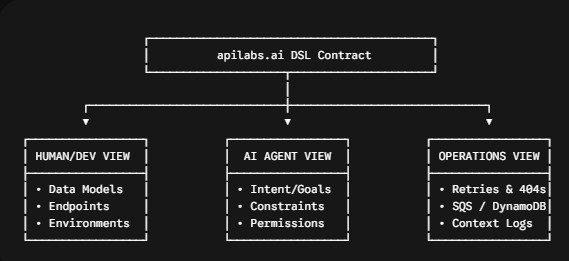
Why apilabs.ai DSL?
Traditional API specifications focus on documentation.
The apilabs.ai API Contract DSL is built for execution.
From a single contract, generate and operate:
- ◆ API Documentation
- ◆ OpenAPI Specifications
- ◆ Test Suites
- ◆ MCP Tools
- ◆ AI Agent Actions
- ◆ Workflow Automation
- ◆ Mock APIs
- ◆ CI/CD Pipelines
- ◆ Monitoring & Observability
- ◆ Runbooks
Semantic API Architecture
Core Execution
Environment Management • Authentication • Routes • Workflows
Execution Enhancements
Testing • Recovery Policies • Runtime Context
Domain Modeling
Models • Operations
AI Awareness
Business Semantics (Goal, Actor, Trigger, Outcome, Rules) • Agent Semantics (Permissions, Constraints) • Events • Infrastructure
Philosophy
Traditional API specifications describe endpoints.
The apilabs.ai API Contract DSL describes how systems behave.
Beyond requests and responses, it captures business intent, workflows, state transitions, recovery logic, agent permissions, events, and runtime context—allowing AI agents to safely execute, test, validate, observe, and automate APIs and MCPs.
Core Principles
- ◆ Executable, not just documented
- ◆ AI-native and agent-ready
- ◆ Semantic by design
- ◆ Secure by default
- ◆ Git-native
- ◆ Observable
- ◆ Human and AI readable
AI-Native APIOps
A single contract becomes the foundation for API development, testing, workflow automation, agent execution, observability, and operations.
Write once. Generate, execute, test, observe, and automate everywhere.
Example: Orders API — Minimal Optimized
# =============================================================================
# SUPERCONTRACTS™ MVP — DRAFT SPECIFICATION
# Copyright © API Labs. All rights reserved.
#
# STATUS: Draft / evolving specification. Not a finalized 1.0 standard.
# PURPOSE: Use this minimal spec for prototypes, developer onboarding, local
#          execution, basic API workflows, tests, policies, approvals, agents,
#          MCP exposure, and runtime evidence.
# SOURCE OF TRUTH: This file defines the supported minimal structure. Examples
#                  in documentation are illustrative and may omit required fields.
# GUIDANCE: Start here unless enterprise-grade controls, deep observability,
#           reusable policy domains, or advanced identity controls are required.
# =============================================================================

# -----------------------------------------------------------------------------
# CONTRACT METADATA
# WHEN TO USE: Always. Identifies the contract, version, owner, and purpose.
# Keep IDs stable; increment version when behavior, policy, or schema changes.
# -----------------------------------------------------------------------------
contract:
  spec: supercontracts
  spec_version: "1.0"
  id: order-processing
  version: "2.1.0"
  description: Create, retrieve, test, and govern customer orders.
  owner: fulfillment-platform
  tags: [orders, fulfillment]

# -----------------------------------------------------------------------------
# SERVICE DEFAULTS
# WHEN TO USE: Define shared protocol defaults such as timeout, content type,
# authentication, and the default execution environment.
# -----------------------------------------------------------------------------
service:
  name: Order Processing Service
  default_environment: development
  defaults:
    timeout: 30s
    content_type: application/json
    auth: order_bearer

# -----------------------------------------------------------------------------
# ENVIRONMENTS
# WHEN TO USE: Use whenever the same contract runs against development, staging,
# or production. Mark production explicitly and use secure tunnels for private APIs.
# -----------------------------------------------------------------------------
environments:
  production:
    base_url: https://api.fulfillment.io/v2
    production: true
  staging:
    base_url: https://staging-api.fulfillment.io/v2
  development:
    base_url: http://localhost:8080/v2
    secure_tunnel: true

# -----------------------------------------------------------------------------
# AUTHENTICATION AND SECRETS
# WHEN TO USE: Use for APIs requiring credentials. Reference external secret stores;
# never place raw tokens, passwords, or production keys directly in this file.
# -----------------------------------------------------------------------------
auth:
  order_bearer:
    type: bearer
    in: header
    header: Authorization
    secret:
      production: aws-sm://orders/prod/access-token
      staging: aws-sm://orders/staging/access-token
      development: env://ORDER_TOKEN
    redact: true

# -----------------------------------------------------------------------------
# SCHEMAS
# WHEN TO USE: Define reusable input, output, identifier, and error structures.
# Use schemas to validate requests and responses before and after execution.
# -----------------------------------------------------------------------------
schemas:
  OrderId:
    type: string
    pattern: '^ord_[A-Za-z0-9]{12}#x27;

  Sku:
    type: string
    pattern: '^[A-Z]{3}-[A-Z]{3}-[0-9]{3}#x27;
    minLength: 11
    maxLength: 11

  Quantity:
    type: integer
    minimum: 1
    maximum: 10

  Order:
    type: object
    additionalProperties: false
    required: [order_id, sku, quantity, status]
    properties:
      order_id: { $ref: '#/schemas/OrderId' }
      sku: { $ref: '#/schemas/Sku' }
      quantity: { $ref: '#/schemas/Quantity' }
      status:
        type: string
        enum: [pending, processing, shipped, cancelled]

  OrderCreate:
    type: object
    additionalProperties: false
    required: [sku, quantity]
    properties:
      sku: { $ref: '#/schemas/Sku' }
      quantity: { $ref: '#/schemas/Quantity' }

  Error:
    type: object
    additionalProperties: false
    required: [code, message, correlation_id]
    properties:
      code: { type: string }
      message: { type: string }
      correlation_id: { type: string }

# -----------------------------------------------------------------------------
# API OPERATIONS
# WHEN TO USE: Define each callable API action, including method, path, risk,
# authentication, inputs, responses, policies, and emitted events.
# -----------------------------------------------------------------------------
operations:
  place_order:
    method: POST
    path: /orders
    effect: write
    risk: medium
    auth: order_bearer
    request:
      body:
        required: true
        schema: { $ref: '#/schemas/OrderCreate' }
      headers:
        Idempotency-Key:
          required: true
          type: string
    responses:
      '201': { schema: { $ref: '#/schemas/Order' } }
      '400': { schema: { $ref: '#/schemas/Error' } }
      '401': { schema: { $ref: '#/schemas/Error' } }
      '409': { schema: { $ref: '#/schemas/Error' } }
    policies:
      - production_write_approval
      - place_order_rate_limit
      - redact_sensitive_data
      - capture_evidence
    emits: [order_created]

  get_order:
    method: GET
    path: /orders/{order_id}
    effect: read
    risk: low
    auth: order_bearer
    parameters:
      path:
        order_id:
          required: true
          schema: { $ref: '#/schemas/OrderId' }
    responses:
      '200': { schema: { $ref: '#/schemas/Order' } }
      '401': { schema: { $ref: '#/schemas/Error' } }
      '404': { schema: { $ref: '#/schemas/Error' } }
    policies:
      - order_lookup_retry
      - redact_sensitive_data
      - capture_evidence

# -----------------------------------------------------------------------------
# WORKFLOWS
# WHEN TO USE: Use for multi-step business actions with dependencies, saved state,
# assertions, retries, conditional behavior, or escalation paths.
# -----------------------------------------------------------------------------
workflows:
  order_lifecycle:
    description: Create an order and verify that it can be retrieved.
    input: { $ref: '#/schemas/OrderCreate' }
    initial_state:
      order_exists: false
    steps:
      - id: submit
        uses: operation.place_order
        with:
          body: $input
          headers.Idempotency-Key: $context.idempotency_key
        save:
          order_id: $response.body.order_id
          order_status: $response.body.status
        assert:
          status: 201
          body.status: pending

      - id: inspect
        uses: operation.get_order
        with:
          path.order_id: $state.order_id
        retry: order_lookup_retry
        assert:
          status: 200
          body.order_id: $state.order_id
          body.sku: $input.sku
          body.quantity: $input.quantity
          body.status: pending
        on_failure:
          emit: order_lookup_failed
          action: escalate

    success:
      state:
        order_exists: true
        order_status: pending

# -----------------------------------------------------------------------------
# POLICIES
# WHEN TO USE: Use to enforce approvals, retries, rate limits, redaction, and
# evidence capture consistently across operations and workflows.
# -----------------------------------------------------------------------------
policies:
  defaults:
    fail_closed: true
    deny_unlisted_operations: true

  production_write_approval:
    type: approval
    match:
      environments: [production]
      effects: [write, destructive]
    require:
      approver_group: fulfillment-operations
      timeout: 15m
      on_timeout: reject
    evidence: [requester, approver, decision, reason, timestamp]

  order_lookup_retry:
    type: retry
    match:
      operation: get_order
      status: 404
    attempts: 3
    delay: 1s
    backoff: exponential
    max_delay: 5s

  place_order_rate_limit:
    type: rate_limit
    match:
      operation: place_order
    limit: 10
    window: 1m
    key: $actor.id
    on_exceed: block

  redact_sensitive_data:
    type: redaction
    paths:
      - $request.headers.authorization
      - $request.body.pii
      - $response.body.pii
    replacement: '[REDACTED]'

  capture_evidence:
    type: evidence
    capture:
      - actor
      - environment
      - request
      - response
      - policy_decisions
      - approvals
      - state_changes
      - assertions
      - retries
      - timestamps
      - execution_trace
    exclude:
      - secrets
      - authorization_tokens
      - hidden_model_reasoning

# -----------------------------------------------------------------------------
# AI AGENT GUARDRAILS
# WHEN TO USE: Use when an AI agent can call operations or workflows. Explicitly
# allow approved actions and environments; deny everything else by default.
# -----------------------------------------------------------------------------
agents:
  order_assistant:
    description: Support agent for creating and tracking orders.
    allow:
      operations: [place_order, get_order]
      workflows: [order_lifecycle]
      environments: [development, staging, production]
    deny:
      - unlisted_operations
      - direct_database_access
      - secret_access
    constraints:
      production_writes: approval_required
      max_quantity: 10
      max_actions_per_request: 1
      require_idempotency_for_writes: true
      require_post_write_verification: true
      prevent_duplicate_orders: true
    escalate_on:
      - approval_rejected
      - retry_exhausted
      - policy_blocked
    interfaces:
      slack:
        enabled: true
        bot_handle: '@OrderBot'
        allowed_channels: ['#support-ops', '#order-triage']
        require_thread_context: true
        require_actor_identity: true

tests:
  fixtures:
    valid_order: { sku: APP-YKM-992, quantity: 3 }

  cases:
    order_lifecycle_smoke:
      target: workflow.order_lifecycle
      environment: staging
      input: $fixtures.valid_order
      expect:
        status: success
        steps: { submit: 201, inspect: 200 }
        state: { order_exists: true, order_status: pending }

    reject_quantity_above_limit:
      target: operation.place_order
      environment: staging
      input: { sku: APP-YKM-992, quantity: 11 }
      expect: { status: 400 }

    require_production_approval:
      target: operation.place_order
      environment: production
      input: $fixtures.valid_order
      expect: { policy_decision: approval_required }

  generate:
    from: [schemas, operations, workflows, policies]
    categories: [edge, negative, schema, security, workflow]
    require_review: true

events:
  order_created:
    when: { operation: place_order, status: 201 }
    publish:
      topic: orders.created
      payload:
        order_id: $response.body.order_id
        status: $response.body.status
        correlation_id: $context.correlation_id

  order_lookup_failed:
    when: { workflow: order_lifecycle, step: inspect, condition: retry_exhausted }
    publish:
      topic: orders.lookup.failed
      payload:
        order_id: $state.order_id
        correlation_id: $context.correlation_id

runtime:
  correlation_id:
    generate: true
    response_header: X-Correlation-ID
  evidence:
    path: .supercontracts/runs/$run.id
    outputs:
      run: run.json
      state: state.json
      steps: steps.json
      events: events.jsonl
      io: io.json
      ai_context: ai_context.md
    integrity:
      hash_artifacts: true
      append_only_events: true
  ai_context:
    include:
      - execution_summary
      - policy_decisions
      - approval_history
      - failed_assertions
      - retry_history
      - final_state
      - remediation_hint
    exclude: [secrets, authorization_headers, hidden_model_reasoning]

mcp:
  server:
    name: order-service-mcp
    version: "1.0.0"
  tools:
    place_order: { uses: operation.place_order, risk: medium }
    get_order: { uses: operation.get_order, risk: low }
    run_order_lifecycle: { uses: workflow.order_lifecycle, risk: medium }
  safety:
    strict_mode: true
    deny_unlisted_tools: true
    validate_inputs: true
    validate_outputs: true
    enforce_agent_permissions: true
    enforce_environment_policies: true
  ide:
    cursor:
      enabled: true
      capabilities: [discover, execute, test, audit]
      evidence_path: .supercontracts/runs
      expose_decision_summary: true
      expose_hidden_model_reasoning: false

infrastructure:
  references:
    orders: { type: dynamodb, resource: orders }
    fulfillment: { type: sqs, resource: order-processing }