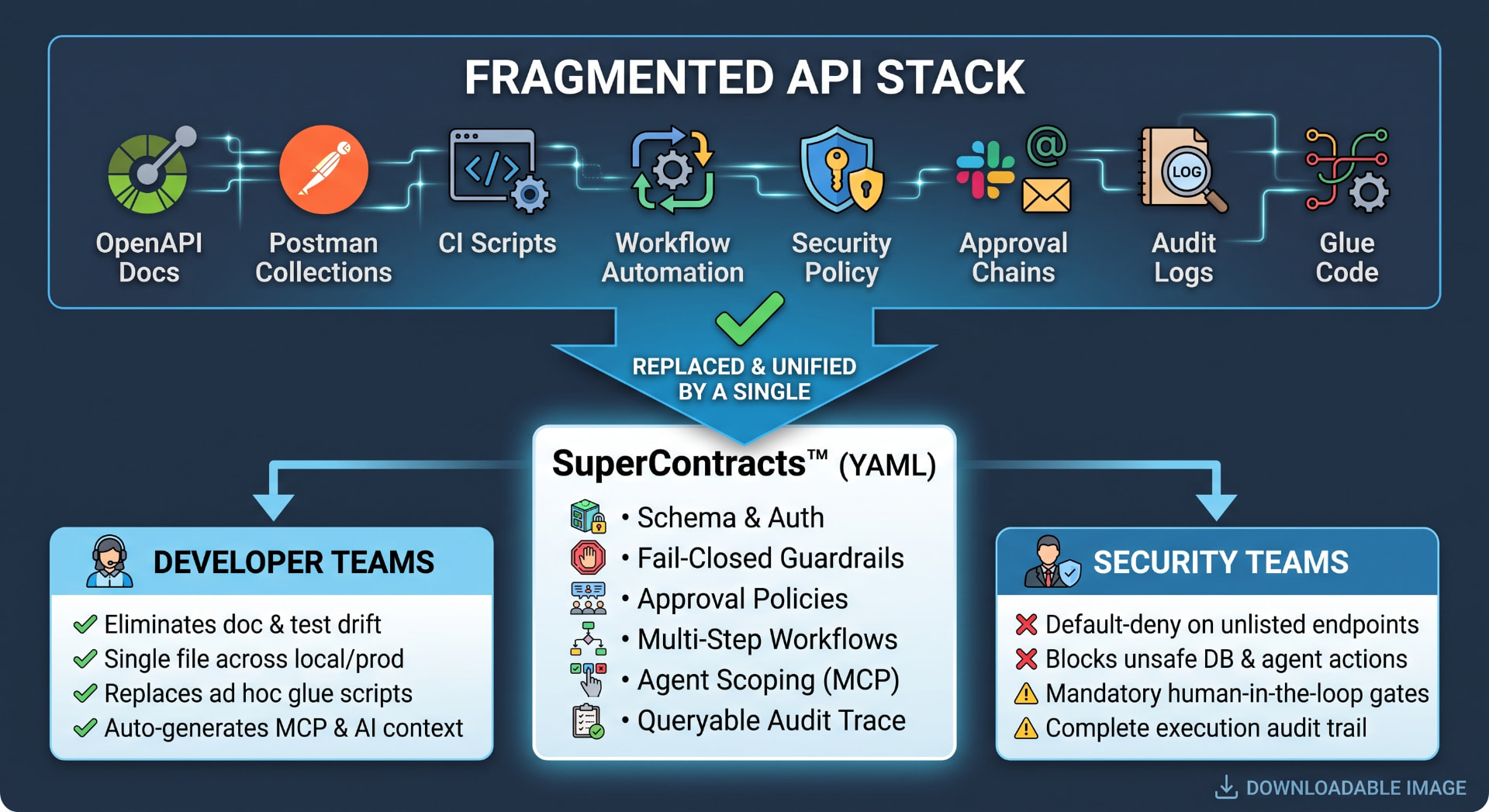
What SuperContracts and Agentic Security from apilabs.ai solve for Security and Developer teams
SuperContracts replaces a fragmented stack — OpenAPI docs, Postman™ collections, CI scripts, workflow automation, security policy, Slack/email approval chains, and audit logs — with a single executable YAML contract that defines what a system does, how it should be tested, who can call it, and what happens when something risky is attempted.
Full spec and live examples: apilabs.ai/supercontracts and apilabs.ai/help/api-dsl-spec-draft. Open-source repo: github.com/apilabs-ai/supercontracts.
For Security Teams: Close the Agent Governance Gap
SuperContracts closes the gap that opened once agents started executing real actions instead of just generating code. The spec defines:
- Fail-closed defaults — unlisted operations are denied by default.
- Explicit AI agent guardrails — allow/deny lists per operation, workflow, and environment.
- Approval policies — route high-risk or production writes to a named approver group with a timeout and reject-on-timeout behavior.
- An evidence layer — captures actor, request, response, policy decisions, approvals, and execution trace for every call.
This turns "did the agent do something it shouldn't have?" from a forensic guessing exercise into a queryable audit trail.
For Developer Teams: One File for the Entire API Lifecycle
For developer teams, SuperContracts collapses the usual API lifecycle sprawl into one file:
- Request/response schemas
- Auth and environments
- Multi-step workflows with assertions and retries
- Documentation, mock APIs, and MCP tool exposure
- AI-generated test suites — positive, negative, boundary, and security cases
The same contract runs against localhost, staging, and production. There is no separate Postman™ collection or CI script to keep in sync by hand.
Top 10 Pain Points SuperContracts Solves
- OpenAPI/docs drift from actual behavior — the contract is executed, not just read, so spec and test can't silently diverge.
- Multi-step workflows scattered across scripts — chained steps with output passed forward replace ad hoc glue code.
- No automated pass/fail signal on API behavior — test blocks assert status codes and response fields directly against a flow.
- Agents guessing at how to call an API and hallucinating —
generate_ai_contextgives the agent structured execution data instead of guesswork. - Uncontrolled MCP tool calls reaching production systems — guardrails block unsafe calls before they reach connected systems.
- Overly broad agent permissions — explicit allow/deny scoping per operation, workflow, and environment.
- Destructive actions with no human checkpoint — approval policies require sign-off for high-risk actions.
- Dangerous database operations from an agent or MCP tool — allow SELECT, block DROP TABLE and unrestricted DELETE.
- Slack bots / commands with no validation or audit trail — commands are validated against the requesting user, high-risk ones require approval, every action leaves evidence.
- Losing IDE context to test or approve something — Cursor™ MCP integration runs discovery, execution, and audit inline, without leaving the editor.
From Fragmented Stack to One Executable Contract
The diagram above shows the before-and-after. On one side: OpenAPI Docs, Postman™ Collections, CI Scripts, Workflow Automation, Security Policy, Approval Chains, Audit Logs, and Glue Code. On the other side: a single SuperContracts YAML contract that serves Developer Teams and Security Teams at the same time.
Developer Teams eliminate doc and test drift, keep one file across local and production, replace ad hoc glue scripts, and auto-generate MCP and AI context. Security Teams get default-deny on unlisted endpoints, blocks on unsafe database and agent actions, mandatory human-in-the-loop gates, and a complete execution audit trail.
Start Building with SuperContracts
Visit apilabs.ai and explore SuperContracts for Security and Developer benefits. Read the full SuperContracts API spec, browse live examples on GitHub, or see the platform overview at apilabs.ai/supercontracts.