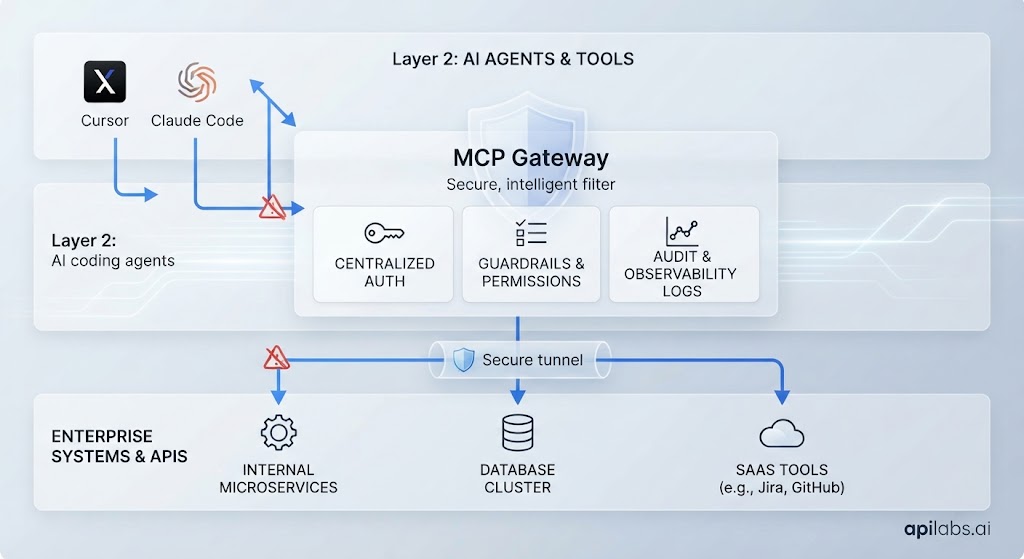
apilabs.ai Agentic Security - SuperContracts MCP Gateway: Govern What AI Agents Are Allowed to Do - Cusor, Claude Code
AI agents are rapidly moving beyond answering questions and generating code. Tools such as Cursor™, Claude Code™, GitHub Copilot™, and Codex™ can now invoke APIs, call MCP tools, execute terminal commands, modify repositories, query databases, and interact directly with production services.
That creates a new enterprise security problem:
How do you give AI agents useful access without giving them unrestricted authority?
Traditional API gateways authenticate requests and route traffic. Traditional developer tools help humans test APIs. Neither was designed for autonomous or semi-autonomous agents that can decide which actions to take, chain multiple tools together, and execute those actions at machine speed.
apilabs.ai SuperContracts MCP Gateway introduces a policy-driven control layer between AI agents and the APIs, MCP servers, SaaS applications, databases, and infrastructure they want to use.
Instead of simply asking:
“Is this agent authenticated?”
SuperContracts asks:
“Is this specific action allowed, under these conditions, for this agent, right now?”
The Problem: MCP Gives Agents Tools — But Tools Need Guardrails
The Model Context Protocol dramatically simplifies how AI agents discover and invoke tools.
An MCP server might expose actions such as:
refund_paymentexecute_sqlcreate_pull_requestupdate_issuedeploy_serviceread_customersend_message
That is incredibly powerful.
But once an agent has access to a tool, enterprises still need to answer more granular questions.
- Should the agent be able to refund $20 or $20,000?
- Should it be able to query customer data but not retrieve PII?
- Should it be able to modify GitHub™ code but never push directly to main?
- Should a production deployment require a human approval?
- Should an agent be allowed to perform ten actions individually but be stopped when their combined blast radius exceeds an acceptable threshold?
These are not simply authentication problems. They are action authorization and governance problems.
SuperContracts: Executable Guardrails for Agent Actions
A SuperContract defines the rules governing how an agent can interact with a service. The contract can describe:
- APIs and MCP tools
- authentication
- allowed actions
- denied actions
- input and output constraints
- sensitive-data policies
- monetary limits
- workflow rules
- Human-in-the-Loop approvals
- runtime conditions
- audit and evidence requirements
The result is an executable policy contract, rather than documentation that an AI agent is merely expected to follow.
An agent can request an action. The SuperContracts MCP Gateway evaluates it. Then the gateway makes a deterministic decision:
ALLOW · DENY · HUMAN APPROVAL
That distinction is important. Prompt instructions tell an agent what it should do. SuperContracts governs what it is actually allowed to do.
Example 1: Stripe™ Refund Guardrails
Consider an AI customer-support agent connected to Stripe™. Giving the agent unrestricted access to a refund MCP tool would create substantial financial risk.
A SuperContract can instead define policies such as:
service: stripe

action: refund

guardrails:
  max_refund_per_transaction: 500
  max_refund_per_customer: 1000
  max_total_refunds_per_day: 5000

approval:
  required_above: 250
Now an agent might request: Refund $75 to customer A. SuperContracts evaluates the action and returns:
ALLOWThe same agent asks: Refund $2,500. The gateway can respond:
DENY
Policy: refund exceeds maximum permitted amount
Or an intermediate transaction might result in:
HUMAN_APPROVAL_REQUIREDThe AI agent still has access to Stripe™. It simply does not have unlimited authority over Stripe™. That is a much more useful enterprise security model.
Example 2: GitHub™ PR-Only Development
Coding agents increasingly modify entire repositories. But enterprises rarely want an autonomous agent pushing directly into a protected production branch.
SuperContracts can enforce a GitHub™ policy such as:
service: github

allow:
  - create_branch
  - modify_file
  - run_tests
  - create_pull_request

deny:
  - push_to_main
  - delete_protected_branch
  - bypass_review
Cursor™ or Claude Code™ can therefore:
Issue → Branch → Modify Code → Test → Pull RequestBut:
Agent → Push directly to main → DENYThe control lives outside the agent’s reasoning. Even if the model makes a mistake, misunderstands instructions, or is manipulated through prompt injection, the governed action remains blocked.
Example 3: Protect PII in Database Workflows
Database agents create an even more interesting challenge. An agent may legitimately need database access while troubleshooting an application, but unrestricted SQL access could expose customer records or sensitive information.
A SuperContract could allow SELECT while applying conditions such as:
WHERE clause required
Row limit <= 100
PII columns redacted
Production DDL prohibited
auth.* schema prohibited
For example:
SELECT email, phone, account_balance
FROM customers;
could be denied or automatically governed because it requests sensitive information without appropriate constraints. Meanwhile:
SELECT status, created_at
FROM orders
WHERE order_id = '123'
LIMIT 10;
could be allowed.
SuperContracts therefore moves authorization deeper than “Can this agent access the database?” to “What exactly can this agent do once it gets there?”
The MCP Gateway Becomes the Policy Enforcement Point
The architecture is straightforward:
Cursor / Claude Code / Copilot / Codex
                 │
                 ▼
        MCP Tool Request
                 │
                 ▼
   SuperContracts MCP Gateway
                 │
          Policy Evaluation
                 │
       ┌─────────┼──────────┐
       ▼         ▼          ▼
     ALLOW      DENY       HITL
       │                    │
       ▼                    ▼
 API / MCP / SaaS      Human Approval
 Database / Cloud            │
                             ▼
                           Execute
Instead of allowing every AI IDE to independently connect to dozens of enterprise systems, organizations gain a central control plane for agent actions. The agent remains intelligent and flexible. The policy layer remains deterministic.
Human-in-the-Loop Where Risk Demands It
Not every high-risk action should simply be blocked. Sometimes the correct policy is: the AI can propose it, but a human must authorize it.
SuperContracts can introduce Human-in-the-Loop approval for actions such as:
- large refunds
- production deployments
- destructive database operations
- high-value transactions
- unusual infrastructure changes
- access to sensitive datasets
- security-sensitive repository changes
The approval could flow through enterprise systems such as Slack™, Jira™, Linear™, email, or another approval workflow. The agent submits the action. SuperContracts pauses execution. An authorized person approves or rejects it. If approved, the agent can continue the workflow.
This preserves AI automation without removing human accountability from high-impact decisions.
Guardrails Across Chained Agent Workflows
The biggest risks often do not come from one API call. They emerge from chains of individually reasonable actions.
Imagine an incident-response agent that can query Datadog™, retrieve customer records, issue a Stripe™ refund, modify GitHub™, notify Slack™, and restart infrastructure. Every individual tool might be authorized. But their combination can create significant operational consequences.
SuperContracts can govern the workflow itself. For example:
Datadog alert
      ↓
Investigate customer impact
      ↓
Query approved database fields
      ↓
Refund affected customer
      ↓
Create GitHub issue
      ↓
Open remediation PR
      ↓
Notify Slack
Policies can be evaluated at each step while maintaining workflow context. This opens the door to more sophisticated guardrails around:
- cumulative financial limits
- action sequencing
- cross-SaaS data movement
- transaction boundaries
- delegated authority
- workflow-level approvals
- blast-radius limits
- circuit breakers
That is where agent governance becomes much more powerful than a conventional API gateway.
SuperContracts as a Shared Policy Language
One of the larger opportunities is making guardrails portable. A SuperContract policy should not need to exist only inside one AI IDE. The same policy can govern actions initiated from Cursor™, Claude Code™, Copilot™, Codex™, an autonomous agent, a CI/CD workflow, an internal application, or another MCP client.
For example, a reusable GitHub™ Guardrail Skill could specify:
skill: github_safe_change

allow:
  - create_branch
  - modify_file
  - create_pull_request

deny:
  - push_to_main
  - delete_repository
A Stripe™ skill could define financial controls. A Supabase™ skill could define data controls. An AWS™ skill could define infrastructure controls. Organizations begin building a reusable library of agent permissions expressed as business-level policies.
From Prompt-Based Safety to Deterministic Enforcement
Many AI security approaches currently depend heavily on prompts:
Never access production.
Do not expose customer data.
Do not push directly to main.
Ask before issuing refunds above $500.
Those instructions remain useful. But they are not a security boundary. Agents can misunderstand them. Context can disappear. Prompt injection can alter model behavior. New tools can create unexpected execution paths.
SuperContracts introduces a separate enforcement layer.
Agent Intent
     ↓
SuperContract Policy
     ↓
Deterministic Decision
     ↓
ALLOW / DENY / APPROVAL
     ↓
Execution
The AI determines what it wants to do. The SuperContract determines whether it may do it. That separation of responsibilities is fundamental to safely deploying increasingly autonomous agents.
Evidence and Auditability
Enterprise governance requires more than blocking actions. Organizations also need to understand:
- Which agent initiated the action?
- Which user or workload delegated authority?
- Which MCP tool was invoked?
- What arguments were supplied?
- Which policy evaluated the request?
- Why was it allowed? Why was it denied?
- Was human approval required? Who approved it?
- What happened afterward?
SuperContracts can generate evidence around each governed execution. Instead of reconstructing an AI agent’s activity from application logs scattered across numerous systems, enterprises gain a common record of:
Agent
→ Intent
→ Tool
→ Policy
→ Decision
→ Execution
→ Evidence
That evidence becomes valuable for security operations, compliance, troubleshooting, incident response, and AI governance.
Beyond MCP: Governing the Agent’s Entire Action Surface
MCP is only one way AI agents interact with infrastructure. Coding agents can also execute git, curl, ssh, kubectl, terraform, aws, python, node, and npm.
That means securing MCP while ignoring terminal execution leaves a significant control gap. The broader apilabs.ai direction is therefore a unified agent-security model:
AI Agent
                    │
        ┌───────────┴───────────┐
        ▼                       ▼
     MCP / APIs               Terminal
        │                       │
        ▼                       ▼
SuperContracts Gateway    Agent Security
        │                 Hooks + Runtime
        └───────────┬───────────┘
                    ▼
            Policy Guardrails
                    │
             ALLOW / DENY
             HUMAN APPROVAL
                    │
                    ▼
                 Evidence
The same fundamental principle applies at both boundaries: observe what the agent is attempting, evaluate policy before the action executes, and preserve evidence of the decision.
A New Control Plane for the Agentic Enterprise
API gateways were built for applications. IAM systems were built for users and workloads. Developer security tools were built primarily for human developers.
AI agents introduce something different: software capable of dynamically deciding which systems to interact with, which tools to invoke, and which sequence of actions to execute. That requires a new layer of governance.
apilabs.ai SuperContracts MCP Gateway is designed to become that action-control layer. It turns MCP access from “The agent has this tool.” into “The agent may perform these specific actions, under these specific conditions, with these limits, approvals, and evidence requirements.”
That shift — from tool access to governed action — may become one of the most important security primitives for enterprise AI agents.
Because the future is not simply about giving agents more tools. It is about giving them exactly enough authority to get the job done — and no more.
Visit apilabs.ai to see Agentic Security — MCP Gateway in action.
Disclaimer: Cursor™ is a trademark of Anysphere, Inc. Claude Code™ is a trademark of Anthropic PBC. GitHub™ and GitHub Copilot™ are trademarks of GitHub, Inc. Codex™ is a trademark of OpenAI. Stripe™ is a trademark of Stripe, Inc. Supabase™ is a trademark of Supabase, Inc. Slack™ is a trademark of Slack Technologies, LLC. Jira™ is a trademark of Atlassian Corporation. Linear™ is a trademark of Linear Orbit, Inc. Datadog™ is a trademark of Datadog, Inc. AWS™ is a trademark of Amazon.com, Inc. apilabs.ai is not affiliated with, endorsed by, or sponsored by any of these organizations.