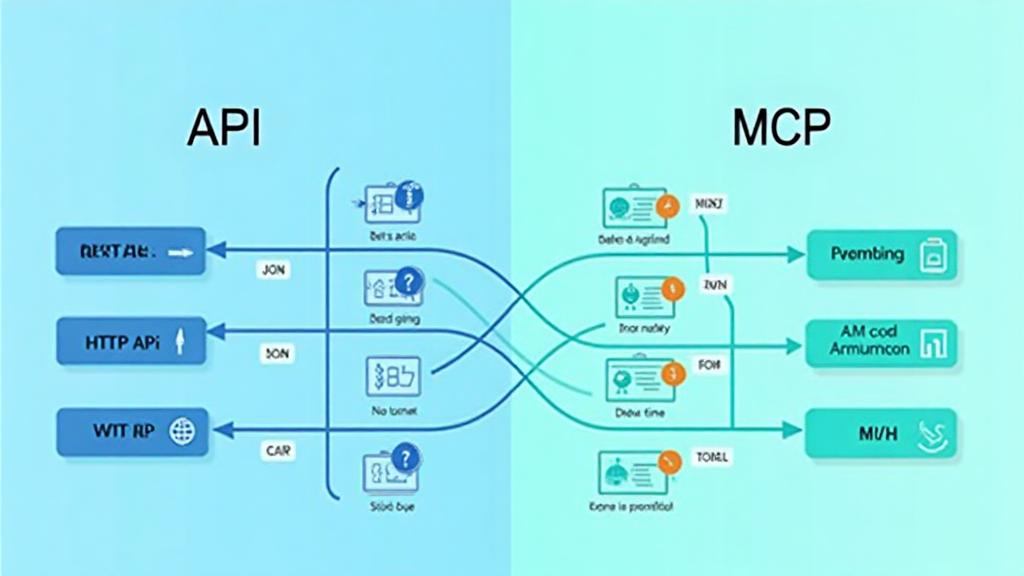
MCP Toolset Overview - API vs MCP overview
MCP (Model Context Protocol) is a modern protocol designed for managing and interacting with AI/ML models and systems in a structured, event-driven, and data-centric way.
It differs from traditional APIs by often incorporating long-lived connections (like SSE) and model-oriented operations.
🛠️ Tools in MCP Toolset
| Tool | Description |
|---|---|
| MCP Studio | GUI or IDE-like interface for testing, visualizing, and debugging MCP endpoints. Common in tools like API Labs apilabs.ai. |
| MCP CLI | Command-line tool to send MCP commands, manage models, and stream events. |
| AI Agents | Micro-orchestrators that communicate with MCP endpoints to perform tasks automatically. |
| Webhook Listener | Tool to listen for async responses or streamed events from MCP. |
| Event Logger | Captures and stores SSE logs for replay, audit, or debugging. |
📡 MCP Methods
These are analogous to HTTP verbs in REST APIs but designed for data + model workflows:
| Method | Purpose |
|---|---|
| GET_MODEL | Retrieve metadata or status of a model |
| POST_DATA | Send input data for inference or training |
| STREAM_RESULT | Subscribe to model output in real time |
| CONFIG_UPDATE | Apply configuration changes to the model |
| SUBSCRIBE_EVENT | Listen to internal model/system events |
These methods may be invoked over HTTP or SSE endpoints.
🌐 MCP Endpoints
1. HTTP Endpoints
Purpose: Used for one-off requests like CRUD operations or batch inference.
Usage: Send a POST or GET request with JSON payloads.
2. SSE Endpoints (Server-Sent Events)
Purpose: Enable real-time, unidirectional streaming from server to client.
Usage: Client subscribes once, and server pushes updates or model outputs continuously.
📦 Passing JSON Parameters
MCP supports structured input via JSON, typically passed in:
- HTTP Body for REST-style requests (POST /mcp/train)
- Query Parameters for lightweight data (GET /mcp/status?model_id=abc)
- SSE Initialization via query or HTTP headers (GET /mcp/stream?session_id=xyz)
Example JSON Payload
🧠 Key Differences from Traditional APIs
| Feature | API | MCP |
|---|---|---|
| Protocol | HTTP (stateless) | HTTP + SSE (stateful/event-driven) |
| Interaction | Request-response | Request-response + real-time streaming |
| Data Flow | CRUD focused | Model/data orchestration focused |
| Tooling | Postman, Swagger, API Labs apilabs.ai | API Labs apilabs.ai, custom MCP clients |