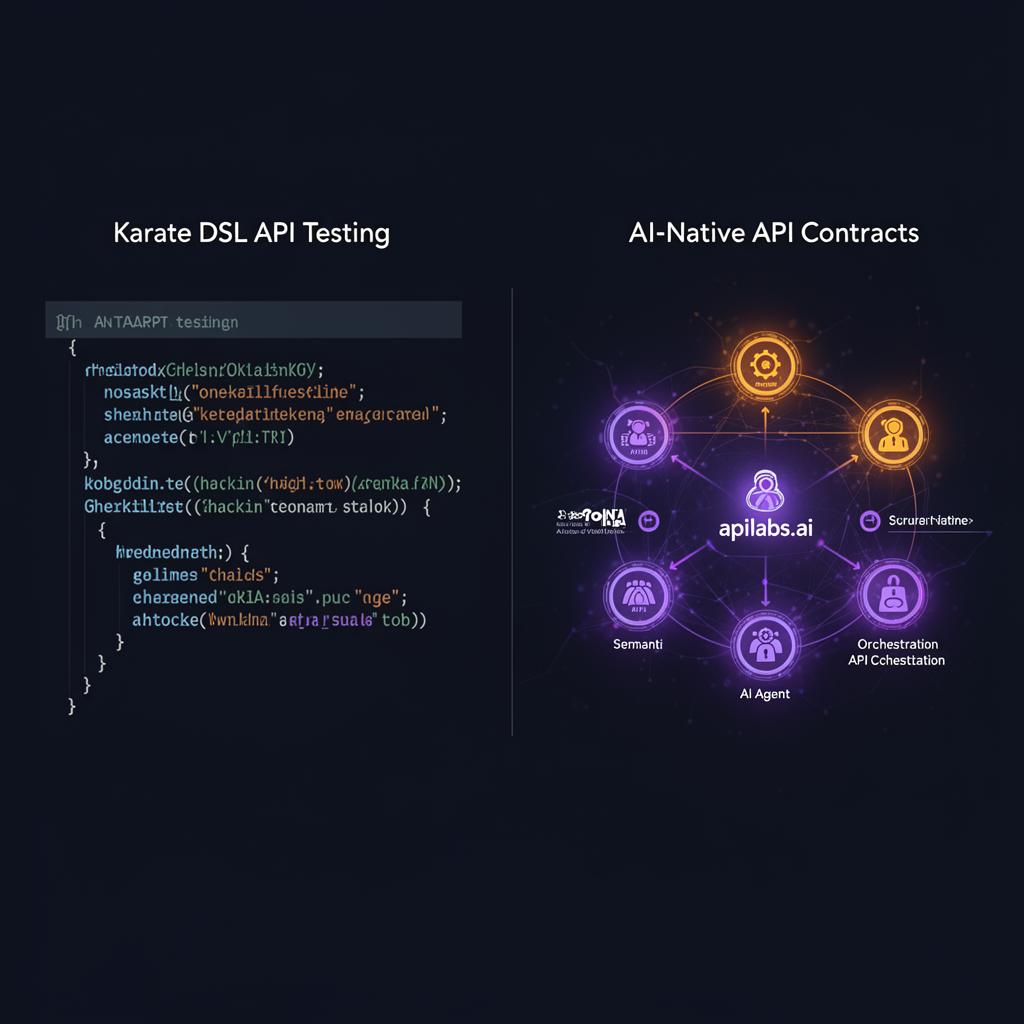
Karate DSL vs apilabs.ai API DSL — The Shift from API Testing to AI-Native APIOps
For nearly a decade, tools like Karate DSL have been a savior for engineering teams. By introducing a readable, Gherkin-style syntax to API testing, Karate abstracted away the boilerplate of traditional Java-heavy frameworks. It made writing API tests faster, cleaner, and highly accessible.
But the AI era has fundamentally rewritten the problem space.
Modern APIs are no longer just static endpoints to be periodically verified by a CI/CD pipeline. Increasingly, they are evolving into:
- Execution primitives for autonomous AI agents.
- Dynamic workflow building blocks that cross system boundaries.
- Observable runtime systems requiring continuous tracing.
- Secure automation layers that must run anywhere—including local developer environments.
This is where the paradigm splits. Karate DSL is an API testing language. The apilabs.ai API DSL is an AI-native API contract.
To understand where the industry is heading, we have to look past simple feature checklists and examine a fundamental architectural shift: moving from testing execution to exposing API semantics.
The Core Difference: Scripted Execution vs. Semantic Operating Models
The difference between a traditional testing framework and an AI-native contract lies in what the underlying file is designed to do. One describes a procedural path for a test runner; the other models the entire runtime infrastructure of the API.
1. Karate DSL Describes How to Run a Test
Karate DSL focuses primarily on scripted API execution. It is highly procedural, instructing the test runner exactly what steps to take in a linear sequence.
Feature: User Management API

Background:
  * url 'https://api.example.com'
  * header Authorization = 'Bearer ' + token

Scenario: CRUD operations
  Given path '/users'
  And request { name: 'Jane', role: 'admin' }
  When method post
  Then status 201
  And match response == { id: '#notnull', **: '#ignore' }
  * def userId = response.id

  Given path '/users/' + userId
  When method get
  Then status 200
  And match response.name == "Jane"
This syntax is beautifully clean for human developers writing deterministic tests. However, it is structurally limited. It is optimized for test runner behavior, heavily dependent on external environment configuration, and leaves the actual structure of the underlying data completely opaque to any external system.
2. apilabs.ai API DSL Describes the API Operating Model
The apilabs.ai API DSL Contract is not a script; it is a unified, declarative blueprint. It maps the routes, models, authentication, and execution graphs into a single, multi-purpose artifact.
api:
  name: User Management API
  version: 1.0
  base_url: "{{baseUrl}}"

environments:
  prod:
    base_url: https://api.example.com

auth:
  type: bearer
  secret_ARN: arn:apilabs:auth:token:user-api-prod-token

files:
  user_test_data:
    file_ARN: arn:apilabs:file:user-management-test-data

models:
  CreateUserRequest:
    name: string
    role: string

  UserResponse:
    id: string
    name: string
    role: string

routes:
  - id: create_user
    method: POST
    path: /users
    models_ref:
      request: CreateUserRequest
      response:
        201: UserResponse
    request:
      body:
        name: Jane
        role: admin
    expect:
      status: 201
      model: UserResponse
      assertions:
        - response.id exists
        - response.name == "Jane"
    save:
      user_id: response.id

  - id: get_user
    method: GET
    path: /users/{{user_id}}
    models_ref:
      response:
        200: UserResponse
    expect:
      status: 200
      model: UserResponse
      assertions:
        - response.name == "Jane"

tests:
  - id: user_crud_flow
    steps:
      - route: create_user
      - route: get_user
Contracts as Runtime Infrastructure
This shift is massive. When comparing Karate DSL vs apilabs.ai API DSL, the file is no longer a passive script tucked away in a test folder. It becomes Terraform for APIs or a Kubernetes manifest for API execution.
Because the apilabs.ai structure decomposes the API into distinct, reusable execution units (routes), typed structures (models), and secure data layers (files), a single DSL file serves simultaneously as a reusable API contract, an execution graph, a workflow definition, and an AI-readable schema.
"Karate DSL exposes execution. The apilabs.ai API DSL exposes semantics."
Why AI Agents Need Structured Contracts
Traditional testing frameworks were built for a pre-agentic world. They assume a human manually writes a test, hardcodes or injects tokens from a CI provider, runs it linearly, and checks a pass/fail flag.
But AI systems—whether they are LLMs generating code inside an IDE, automated debugging agents, or autonomous workflows—require deep context. If you feed a procedural script to an AI agent, it has to guess the intent behind the assertions.
An AI system needs structural guardrails. Evaluating Karate DSL vs apilabs.ai API DSL through an agentic lens highlights what an AI needs to natively understand:
- What a specific route explicitly achieves.
- Which data models are canonical and type-safe.
- Which datasets are secure and version-controlled.
- How to compose multiple distinct routes into a reliable graph without breaking authentication.
Karate DSL shows a runner how to execute a scenario. The apilabs.ai API DSL provides the semantic meaning of the infrastructure. This distinction is what makes a system AI-native.
Security Is a First-Class Citizen
One of the steepest hurdles in traditional API testing is the handling of state, data, and secrets. Karate, like most testing suites, expects external tools to manage the environment:
CI/CD Secrets ──> Environment Variables ──> Karate Runner ──> Plaintext ExecutionThis pattern exposes raw tokens to the test runtime environment, creating clear security and compliance challenges for automated systems.
apilabs.ai treats security, datasets, and execution environment variables as first-class citizens directly within its API DSL using secure Amazon Resource Names (ARNs):
auth:
  secret_ARN: arn:apilabs:auth:token:user-api-prod-token
files:
  user_test_data:
    file_ARN: arn:apilabs:file:user-management-test-data
By decoupling actual values from references, the contract gains secret isolation. An AI agent or a developer working within an AI-powered IDE can safely mutate, execute, or extend the DSL without ever gaining exposure to production tokens or raw underlying PII data files. The platform handles credential and data resolution at the runtime layer, ensuring auditable, secure access patterns.
The Paradigm Shift: From API Testing to AI-Native APIOps
This transition represents the next logical step in the evolution of API tooling. We are moving from isolated verification (testing) to continuous lifecycle operations (APIOps).
| Capability | Karate DSL | apilabs.ai API DSL |
|---|---|---|
| API Testing | Yes | Yes |
| Secure Execution | Partial (External handling) | Native (ARN-driven) |
| Workflow Orchestration | Limited (Procedural scripts) | Native (Execution graphs) |
| Reusable API Contracts | Partial (Primarily functional) | Core Architecture |
| AI-Native Semantics | No | Yes |
| Observability | Test Runner Logs | Tracing, Replay, and Debugging |
| Private API Execution | Custom VPN/Network Setup | Secure Tunnel Architecture |
| AI IDE Integration | External plugins | Native layer (Cursor™, Windsurf™, VS Code™) |
| Agentic Execution | Difficult | Designed for it |
Secure Tunneling and the Modern AI IDE
The practical divergence in the Karate DSL vs apilabs.ai API DSL matchup becomes highly apparent when executing against internal architectures (localhost, private Kubernetes clusters, or corporate VPCs). Traditional testing setups require complex network configurations or heavy CI runners deployed inside the perimeter.
apilabs.ai integrates a Secure Tunnel architecture directly into the API operating model. This allows the runtime engine to bridge the gap between local execution environments—like AI-powered IDEs (Cursor™, Windsurf™, VS Code™)—and private infrastructure seamlessly. The contract itself dictates the routing path, making remote secure relays a native capability rather than a networking headache.
The Future: APIs Become Actions for AI
We are witnessing a fundamental transition in how software interacts.
- The Old API World assumed that humans execute APIs and tools test them.
- The AI-Native API World assumes that agents execute APIs continuously and infrastructure orchestrates them.
Old World (Karate DSL):
  Given path '/users' -> When method post -> Then status 201

New World (apilabs.ai API DSL):
  route: create_user -> auth: secret_ARN -> model: UserResponse -> trace: enabled
When your platform natively understands which routes are reusable, which schemas validate the boundaries, and which traces are replayable, it stops being a testing tool. It becomes infrastructure.
APIs are rapidly evolving from static endpoints into executable capabilities for AI systems. The infrastructure layer must evolve with them. Karate DSL will always hold a place as a great framework for human-authored test scripts—but for teams building, running, and orchestrating software in the agentic era, the future belongs to AI-native API contracts.
Checkout https://apilabs.ai
Disclaimer: Karate DSL is a trademark of its respective owner. Postman™ is a trademark of Postman, Inc. Cursor™, Windsurf™, Claude Code™, Codex™, and VS Code™ are trademarks of their respective owners. apilabs.ai is not affiliated with, endorsed by, or sponsored by any of these organizations.