From Conversation to Automation: The apilabs.ai Unified AI-API Operating System
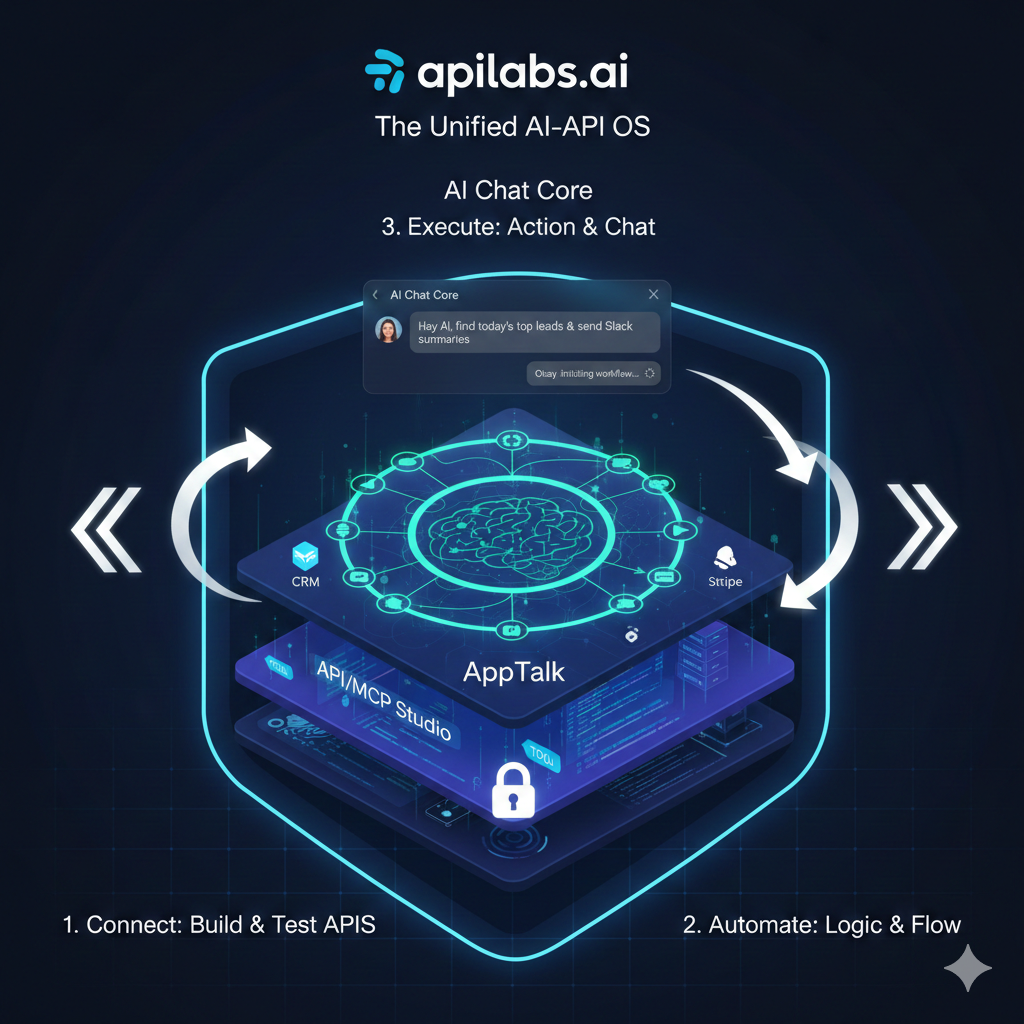
In the rapidly evolving landscape of artificial intelligence, the true power of AI isn't just in generating text or images; it's in its ability to take action. To move beyond mere conversation and truly integrate AI into business operations, a robust framework is needed to bridge the gap between AI models and real-world APIs. This is precisely the challenge apilabs.ai addresses with its unified operating system, comprising three interconnected products: AI Chat Core (MCP Gateway), Agent Flow, and API/MCP Studio.
Together, these components form a seamless cycle, transforming natural language requests into complex automated workflows and tangible business outcomes. Let's explore how they coordinate to achieve this.
1. API/MCP Studio: The Foundation of Connectivity
Every great AI-driven action starts with a reliable connection to data and services. This is where the API/MCP Studio plays its critical role. Think of it as the "laboratory" where the raw materials of automation—APIs and Model Context Protocol (MCP) servers—are discovered, tested, and transformed into usable "Tools" for the AI.
What it does:
The Studio is a sophisticated development environment that allows users to connect to virtually any REST API or MCP server. Its AI-powered auto-discovery intelligently scans endpoints and suggests valid parameters, dramatically reducing the time and effort typically required for API integration.
Coordination:
Once an API is connected and verified in the Studio, it's not just a standalone endpoint; it becomes a "Tool" within the apilabs.ai ecosystem. These verified, authenticated, and ready-to-use Tools are then made available to Agent Flow, ensuring that any subsequent automation has a solid, functional base. Without the Studio, Agent Flow and AI Chat Core (MCP Gateway) would have nothing to connect to or act upon.
2. Agent Flow: The Intelligent Orchestrator
With a robust library of connected Tools from the Studio, Agent Flow steps in as the "brain" of the operation. It's an AI-native orchestration platform designed to build complex, agentic workflows without requiring extensive coding. Where traditional integration platforms rely on rigid "if-then" statements, Agent Flow leverages AI to understand intent and dynamically sequence actions.
What it does:
Agent Flow takes the "Tools" from the Studio and weaves them into intelligent workflows. Instead of manually mapping data fields, you can describe a business objective (e.g., "When a new customer signs up, send them a personalized welcome email, add them to our CRM, and notify the sales team in Slack"). Agent Flow intelligently selects the right API calls, handles data transformations, and ensures the flow executes correctly.
Coordination:
Agent Flow acts as the crucial middle layer. It consumes the capabilities (Tools) provided by the API/MCP Studio and translates high-level goals into a sequence of API calls. It then exposes these orchestrated workflows as "skills" that AI Chat Core (MCP Gateway) can invoke. This separation of concerns ensures that the AI Chat Core (MCP Gateway) doesn't need to understand the intricacies of each API call; it just needs to know which workflow to trigger in Agent Flow.
3. AI Chat Core (MCP Gateway): The Conversational Interface
Finally, the AI Chat Core (MCP Gateway) is the "voice and hands" of the apilabs.ai system—the intuitive front-end where users interact with the entire platform using natural language. It's more than just a chatbot; it's an intelligent agent capable of understanding intent, initiating workflows, and providing relevant feedback.
What it does:
Users can simply type a request, such as "Find today's top 5 leads in Salesforce, generate a summary, and post it to our marketing Slack channel." AI Chat Core (MCP Gateway) processes this request, identifies the underlying intent, and dynamically calls upon the appropriate workflows configured in Agent Flow.
Coordination:
AI Chat Core (MCP Gateway) is the direct user interface. It takes user input, leverages the "skills" (workflows) exposed by Agent Flow, which in turn utilize the verified "Tools" from the API/MCP Studio. The entire cycle is completed as the Chat Core provides real-time updates and results back to the user, effectively closing the loop between a conversational request and an automated action.
The Unified AI-API OS in Action
Imagine a scenario:
API/MCP Studio:
Your developers or data analysts first connect to your CRM, ERP, and communication platforms (e.g., Salesforce, NetSuite, Slack). They use the Studio to test these connections and ensure they are robust and ready for AI interaction.
Agent Flow:
Your business operations team then uses Agent Flow to define a "New Customer Onboarding" workflow. This workflow might involve fetching customer details from Salesforce, creating an invoice in NetSuite, sending a welcome email via an email API, and notifying the customer success team in Slack. Agent Flow seamlessly integrates these individual API calls into a single, intelligent process.
AI Chat Core (MCP Gateway):
A sales manager, needing to quickly onboard a new high-value client, simply types into AI Chat Core (MCP Gateway): "Onboard the new client 'Acme Corp' with the VIP package." The Chat Core understands the intent, triggers the "New Customer Onboarding" workflow in Agent Flow, and provides a confirmation once all the integrated actions (via the Studio's connections) are completed across various systems.
This continuous loop—from connecting and validating APIs in the Studio, to orchestrating complex workflows in Agent Flow, and finally executing them through natural language in AI Chat Core (MCP Gateway)—defines the true power of the apilabs.ai unified operating system. It democratizes the ability to build and deploy intelligent agents, enabling businesses to move from theoretical AI capabilities to practical, impactful automation.