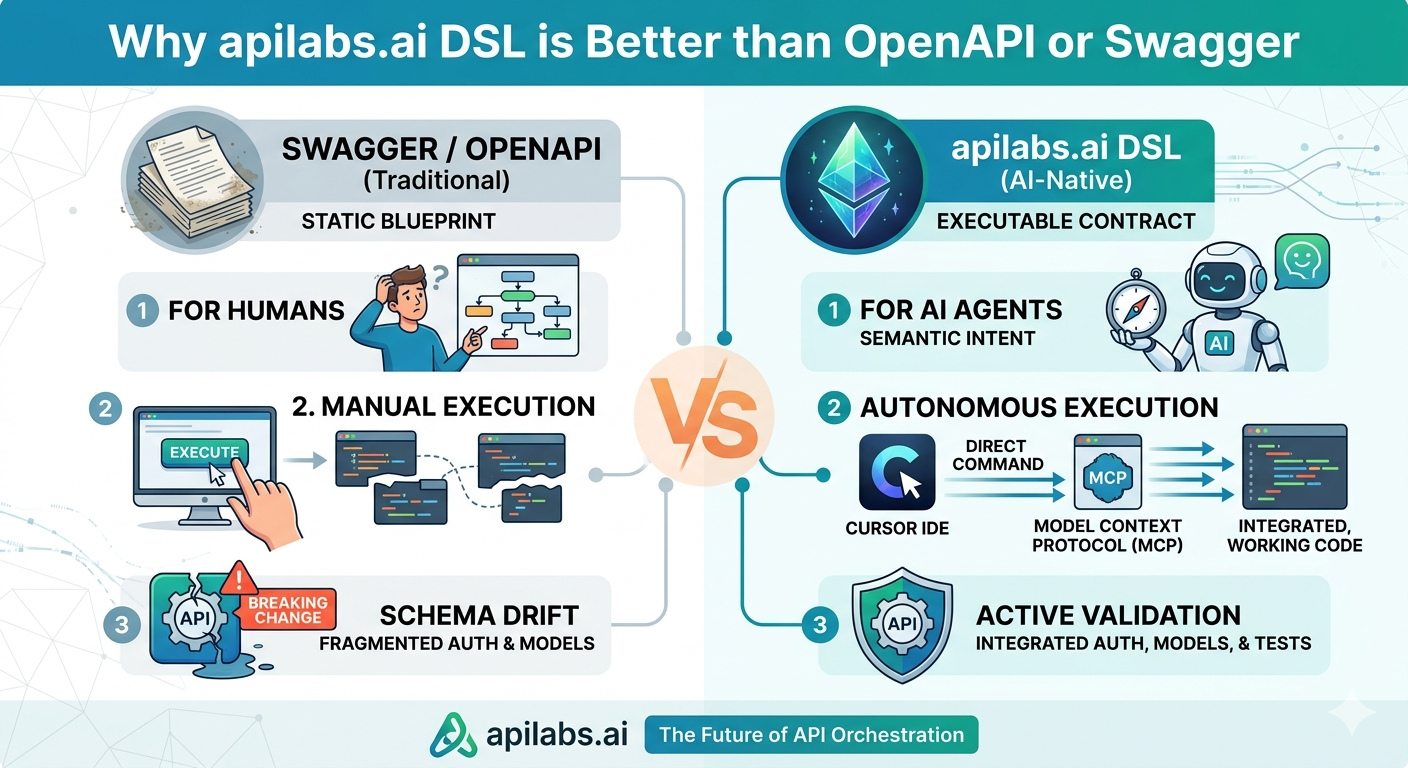
Why apilabs.ai API Contract DSL is Better than OpenAPI or Swagger: Scaling AI-Native Engineering
In the era of AI-driven development and tools like Cursor™, traditional API documentation standards like OpenAPI and Swagger are becoming bottlenecks. While they excel at describing structure for humans, they lack the semantic intelligence and modular orchestration that AI agents need to execute tasks autonomously.
The apilabs.ai API Contract DSL solves this by shifting from static blueprints to executable, AI-native contracts. You can find the full technical details in the apilabs.ai Super Contracts API spec Draft.
The Evolution: From Blueprints to Executable Intent
Traditional documentation tells an AI what an endpoint looks like; apilabs.ai tells an AI how to use it as a functional tool.
1. Unified Logic (The Holistic Contract)
The apilabs.ai DSL consolidates authentication, models, and testing into a single source of truth. By defining intent and expected outcomes rather than just paths, it eliminates the "guesswork" that often leads to LLM hallucinations.
# Schema 1: Integrated Execution
api:
  name: User Management API
  version: 1.0
  auth:
    type: bearer
    secret_ARN: arn:apilabs:auth:token:user-api-prod-token
  routes:
    - id: create_user
      method: POST
      path: /users
      models_ref:
        request: CreateUserRequest
        response: 201: UserResponse
      expect:
        status: 201
        model: UserResponse
In this model, the API becomes a tool. With MCP (Model Context Protocol) integration, an IDE like Cursor™ doesn't just read the documentation — it inherits the secure credentials and assertion logic needed to execute the API call instantly.
2. Enterprise Scalability (The Modular Contract)
As systems grow, the "monolithic YAML" problem of Swagger becomes unmanageable. apilabs.ai introduces Environment-Aware Modularization using ARN-style inclusions.
# Schema 2: Scalable Orchestration
contract:
  name: User Management API
  version: 2.0
  Include:
    env:dev: arn:apilabs:file://api.env.yaml
    auth:prod: arn:apilabs:file://api.auth.yaml
    tests: arn:apilabs:file://api.tests.yaml
Key Comparisons: Why apilabs.ai Wins
Three critical areas where apilabs.ai outperforms traditional Swagger:
Audience: Humans vs. Agents
OpenAPI requires a human to interpret docs and write glue code. apilabs.ai is built for AI Agents, allowing for direct machine-to-machine action.
Maintenance: Reactive vs. Proactive
Swagger files are static and prone to "Schema Drift." apilabs.ai features Active Validation, where AI-driven drift detection flags breaking production changes the moment they happen.
Efficiency: Verbose vs. Compressed
Traditional YAML wastes expensive LLM context windows. apilabs.ai uses Semantic Compression to pack complex logic into a fraction of the tokens.
Conclusion: The New Standard for AI Orchestration
By utilizing the apilabs.ai API Contract DSL, engineering teams can bridge the gap between static code and active AI reasoning. Whether it is through better LLM performance or integrated security via Secret ARNs, apilabs.ai provides the infrastructure required for the next generation of AI-native software.
For a deep dive into the syntax and rules, visit the Super Contracts API spec page.
Check out https://apilabs.ai — Make APIs Agent-Ready
Disclaimer: OpenAPI™ is a trademark of the Linux Foundation. Swagger™ is a trademark of SmartBear Software. Cursor™ is a trademark of Anysphere, Inc. apilabs.ai is not affiliated with, endorsed by, or sponsored by any of these organizations.